Sunday, 9 October 2011

Hartshead Church, Luddites, Patrick Bronte and Robin Hood

A wet day in October - autumn has well and truly arrived.  Hartshead lies between Brighouse and Mirfield.  The map was unhelpful, that's my excuse and I'm sticking to it.  Either that or all roads lead to Robert Town.
Hartshead Church is best known these days as one of Patrick Bronte's curacies.  He lived in the farm across the way from the church during his time here and it was during his stay that the Luddites' protest about the loss of their jobs to mechanisation became violent. 

Their attack on Rawfolds Mill in April 1812 led to the deaths of some of the protesters.  The funerals for the men who were left at Rawfolds or who died after capture were highly publicised but it is also believed that some badly injured men escaped from the mill and died elsewhere.  These men were buried quietly in Hartshead Churchyard according to legend and according to Patrick Bronte. 

They aren't the only mysterious burials in the churchyard.  There is a medieval slab near the door that allegedly belongs to Robin Hood, though this is clearly a matter of some argument.   More real is the trunk of the ancient yew tree in the middle of the church yard, the stocks across the road and the twelfth century tower.  Much of the church was rebuilt in 1881 but the South door is also Norman in origin

Sunday, 2 October 2011

The Dumb Steeple and the Luddites

The busy roundabout where the A62 and A644 meet just outside Huddersfield is an unusual stoppoing spot - and actually you can't.  The nearest car park belongs to The Three Nuns Pub just up the road, so we had an ideal excuse to stop for lunch.  There's been a pub on the site of the Three Nuns since the fifteenth century.  The current building has been there since the nineteenth century.  The name comes from the fact that it stands inside the grounds of Kirklees Priory where Robin Hood is said to have been buried.  There's more to find out about Kirklees Priory in nearby Mirfield.  It's on my list of places to explore.

But back to the Dumb Steeple.  Its easy to miss it if you don't know that its there and no one is really clear as to what its doing where it is.  One theory says that it marks the spot where wanted men could claim sanctuary from the law for forty days and forty nights.  If that is the case then Dumb Steeple is a corruption of Doom Steeple.  History suggests that this isn't the case. Another theory says that it was a marker to show the way to a nearby ford; yet another theory declares that it replaced an ancient megalith.

The dumb steeple's real history dates from  April1812 when the Luddites, disgruntled croppers who were losing their livelihoods to the new cropping machines, met in the fields behind the dumb steeple. Croppers were important workers in the manufacture of finished cloth.  Once the weavers had created the cloth, the croppers used enormous shears to finish it and to raise the nap.  Their trade was a highly skilled one which commanded good wages until the advent of a machine that could do the work of many men. 

In a bid to prevent the loss of their jobs they began to destroy the machines.  On the 11th April 1812 a group of Luddites met at the dumb steeple before marching on Rawfolds Mill near Cleckheaton.  The owner of Rawfolds was prepared and there was a pitched battle.  For a while the authorities feared that Huddersfield and Halifax were fermenting rebellion.  There were more soldiers in the north than Wellington had in the Peninsula Campaign. 
Cars thunder by, their occupants look slightly bewildered at the sight of me with my camera.  Clearly they have no idea of the momentous events that took place here two hundred years ago.

Friday, 2 September 2011

Wakefield

It's been a while but hopefully I'm back on track now- the plan to walk more suffered during the rather damp summer. 

Wakefield, the administrative centre for the West Riding, became a city in 1888 which meant that its parish church became a cathedral.   It's a small but perfectly formed building filled with angels .  It also has the tallest spire in Yorkshire.  It's 247 ft (49m) high. It's a useful tool to help pedestrians find their bearings if they get lost. I enjoyed finding the medieval carvings of animals and green men.  The striking rood screen with its crouching hare carving dates from the seventeenth century.  The cathedral was an excellent reason for revisiting Wakefield but although its shopping centre is being redeveloped it currently isn't a shopper's paradise. 

I paused for a while to enjoy the modern fountain outside the tourist information office then set off to find the Hepworth Art Gallery.  The building wasn't quite what I was expecting -  but then what do I know about modern architecture?  The interior more than lived up to expectations.  There's over 1,600 square metres of exhibition space making it the largest purpose built art space outside London - and its in Wakefield!  The reason, well, Dame Barbara Hepworth was born in Wakefield.

Friday, 10 June 2011

Rotherham, town of foundries and peanuts.

I've been going to Rotherham every week for the past year- for work rather than pleasure I should add.  Its not really the kind of place that you take a camera even though one of the roundabouts on the ring road proclaims that Rotherham is the home of a well known peanut packager.  Most of Rotherham town centre with the exception of the church, parts of the F.E college and a tiny fifteenth century chantry is modern.  At the moment the church is hidden by scaffolding and the chantry is lost in a sea of concrete.  In fact it took me a while to find it even though I'd walked straight by it often enough without really ever noticing it.  I find myself wondering how much air raids of World War Two are to blame and how much modern town planners are responsible for Rotherham's current look.  Having said that it takes on a totally different character on a sunny Tuesday in the summer when the street market fills the middle of Rotherham with yellow and green awnings and tempting smells.

Arthur Mee describing the town in 1941 said that 'it is busy with collieries, a huge electric power station, and great iron, steel and brass foundries.'  Times have changed for Rotherham with many of its high street buildings closed down or occupied by charity shops - the victims of out of town shopping centres.  These days Rotherham is better known for Jamie Oliver's series about teaching people to cook. 

I'll miss the factory shops with their bargain prices and some of the charity shops sell wonderful books at even better prices.  Its certainly a place to bag a bargain on occasion. I'll miss the people that I worked with for so long too but I won't miss the journey, the town centre or the cost of parking.

Saturday, 4 June 2011

York- Stonegate

There's something about York that makes it one of my most favourite cities in the UK- along with Carlisle.  Breakfast in York is something to look forward to as well.  If you're pushing the boat out then there's always Betty's Tearoom with its Art Deco refinement, tinkling ivories and old fashioned service.  And that's before I get as far as actually tucking in to my full Yorkshire breakfast.  Of course, there's history here.  Go down stairs to the basement and you'll find a mirror covered with signatures and emblems.  This is a memorial to the flying crews based around York who came here while they were off duty.  It's easy to loose track of time as you study the names and yourself- it is a mirror after all.

Then its on for a spot of shopping.  St Helen's Square is the lynch pin between old York and the modern shopping centre.  Before the Eighteenth Century it used to be a grave yard but when the new Lord Mayor's mansion was built it was decided that perhaps a mansion with a view of a graveyard wasn't really what the mayor needed.  Recent additions to the grave yard were relocated down Davygate and the graveyard was paved over.  This knowledge has rather ruined my reading of a murder mystery series set in York.  The opening paragraph of the first book has the hero walking across the square.  The only problem is that he's about five centuries too early - or the square is about five centuries too late.  Either way I have difficulty suspending reality after that.  Does anybody else have those kind of problems when they read historical fiction?

Head up Stonegate towards the Minster.  Today its full of designer boutiques, galleries and antique shops.  By mid morning you can hardly move for shoppers and tourists but if you arrive early enough you can enjoy a spot of window shopping and take in the history as well.  Stonegate was the Via Principalis- the main road to the Roman army headquarters- buried beneath the Minster these days.  Its shop fronts echo the Viking shop fronts from Jorvik and if you follow the little alleyways and snickleways you'll find yourself travelling back in time to Medieval York and Eighteenth Century coffee houses.  But if you haven't got time there's always York's little Red Devil chained to his post- a reminder of the printers devil's who used to run with hot print to the presses that filled theses shops.  Lawrence Sterne's Tristam Shandy was published here.  There's a ship's figurehead- slightly dented but a reminder of the tea trade, a medieval Bishop's palace masquerading as a china shop and a royal coat of arms as well as one of York's oldest inns named after Charles I.  He made York his capital for a while.  Though fortunately for York he went to Nottingham before raising his standard and kicking off the English Civil War.  Nottingham paid a heavy price.  York was fortunate in other ways as well.  Thomas, Lord Fairfax, a Parliamentarian who laid siege to this city was a Yorkshireman and ensured no harm came to the city or its wonderful collection of medieval stained glass.

Monday, 16 May 2011

Towton and The Crooked Billet

The weather forecast promised rain but we took a chance on the  battleship grey clouds that plunged across threatening skies.  True to form the skies opened as we joined the motorway and we found ourselves wondering whether we’d made a mistake.  We had a seven mile walk around the site of the Battle of Towton planned after all.

According to some accounts the Lancastrians mustered 30,000 men for this battle although there is now some dispute about the figures.  One thing is certain the Yorkist army was significantly smaller than the Lancastrians drawn up on the ridge above Towton, their right flank protected by the River Cock.  And it was the Lancastrians who chose the battle ground. 

The previous day, the Battle of Ferrybridge had enabled Edward of York to cross the River Aire.  It had also seen the death of Lord Clifford, the man who had killed his twelve year old brother some three months previously. The Yorkist army had to march north before making camp for the night.

It was blustery but not raining when  we arrived in the village of Saxton where we were to start our walk. At least it wasn't snowing like it was in 1461- not ideal conditions for a battle.  In fact it was the snow that probably gave the Yorkists their victory in the end. 

We found Saxton Church and parked.  Then we set off along a country lane lined with hawthorn, in the direction of Towton.  It's odd too how much more noticeable the hills are when you have to walk up them rather than sitting in the comfort of a car.   I wouldn't have fancied a forced march from Ferrybridge- the powerstation dominated the skyline behind me- followed by a night in the cold, finished off by a savage battle that lasted through the hours of daylight.  To be honest I wasn't sure about the seven miles I was just setting off on.

Much to our delight as we joined the road to Towton we spotted a noticeboard and discovered a path.  Further investigation revealed a newly created battlefield walk set up in conjunction with the Royal Armories at Leeds.  Thankfully this walk takes visitors around the battlefield rather than walking along the roadside. Before long we had spotted Lord Dacre's Cross set up in 1928 as a memorial to the battle.  He wasn’t killed at this spot though.  The unfortunate Lancastrian was shot by a boy near an elder tree on the other side of the road. 

According to local folklore, the roses that grow in the hedgerows hereabouts take their colour from a mingling of the red and white rose blood  that was shed that cold Palm Sunday in March.  In fact one of the fields is still known as the ‘Field of the Red and the White Roses.’

The battle started in a blizzard. Yorkist archers sent their arrows deep into the Lancastrian ranks. The wind was against the Lancastrians. Their arrows failed to reach the massed ranks of the Yorkists and in the driving snow they couldn’t even see their enemy.  The Lancastrians had no choice. They advanced down the hill.  For a while it looked as though they would win.  They had superior numbers after all.  

Bloody Meadow
The meadow above the River Cock is still known as 'Bloody Meadow' due to the savage hand to hand fighting that stained the snow red.  When the Lancastrians finally withdrew they found themselves trapped on the wrong side of the River Cock.  The gentle stream of today was a raging torrent  at the time of the battle, carrying winter rains and melted snow. It was impossible for exhausted men or those weighed down in armour to cross the water.  Their woes were compounded by the arrival of Yorkist reinforcements led by the Duke of Norfolk.

Fleeing Lancastrians were finally able to get across the river over the piled up bodies of their comrades. 

The bitterness behind this battle saw the Yorkists summarily execute foot soldiers and nobles alike.  There was no question of being magnanimous in victory.  Despite the killing that continued virtually up to the gates of York itself, Henry VI and his family were able to escape to Scotland.  The civil war was not yet over. Edward of York, now styling himself King Edward IV, was not safe on his throne. The peasants who owed their loyalty to the warring lords were not free from the fear of being called to do battle whether they wanted to or not.

We continued around a field filled with sighing wheat into Towton and then back to Saxton.  There are grave pits on the north side of the church there for some of the 28,000 men said to have been killed that day.  We didn't stop as it was starting to rain again but we did catch a glimpse of Lord Dacre of Gilsland's tomb.  According to the very informative guide published by the Towton Battlefield Society, Lord Dacre was buried upright on his horse and this was apparently confirmed during the nineteenth century. There is also a modern memorial to the men who perished in this chilly part of Yorkshire all those years ago.

Then it was back to The Crooked Billet for a very enjoyable late lunch.  The guidebooks  say that this pub may well be on the site of an earlier inn, which served as the Yorkist headquarters.

It didn't seem to take so long going home as it did to arrive.  May be its the anticipation or not knowing your destination that makes the outwards journey seem longer.  Or perhaps its the anonanymity of the motorway network.  Whatever the reason, next time you’re on the M62 and pass junction 43 give a thought to one of the bloodiest battles ever fought on English soil.

Sunday, 15 May 2011

Ferrybridge- battles, henges and flyovers


Ferrybridge

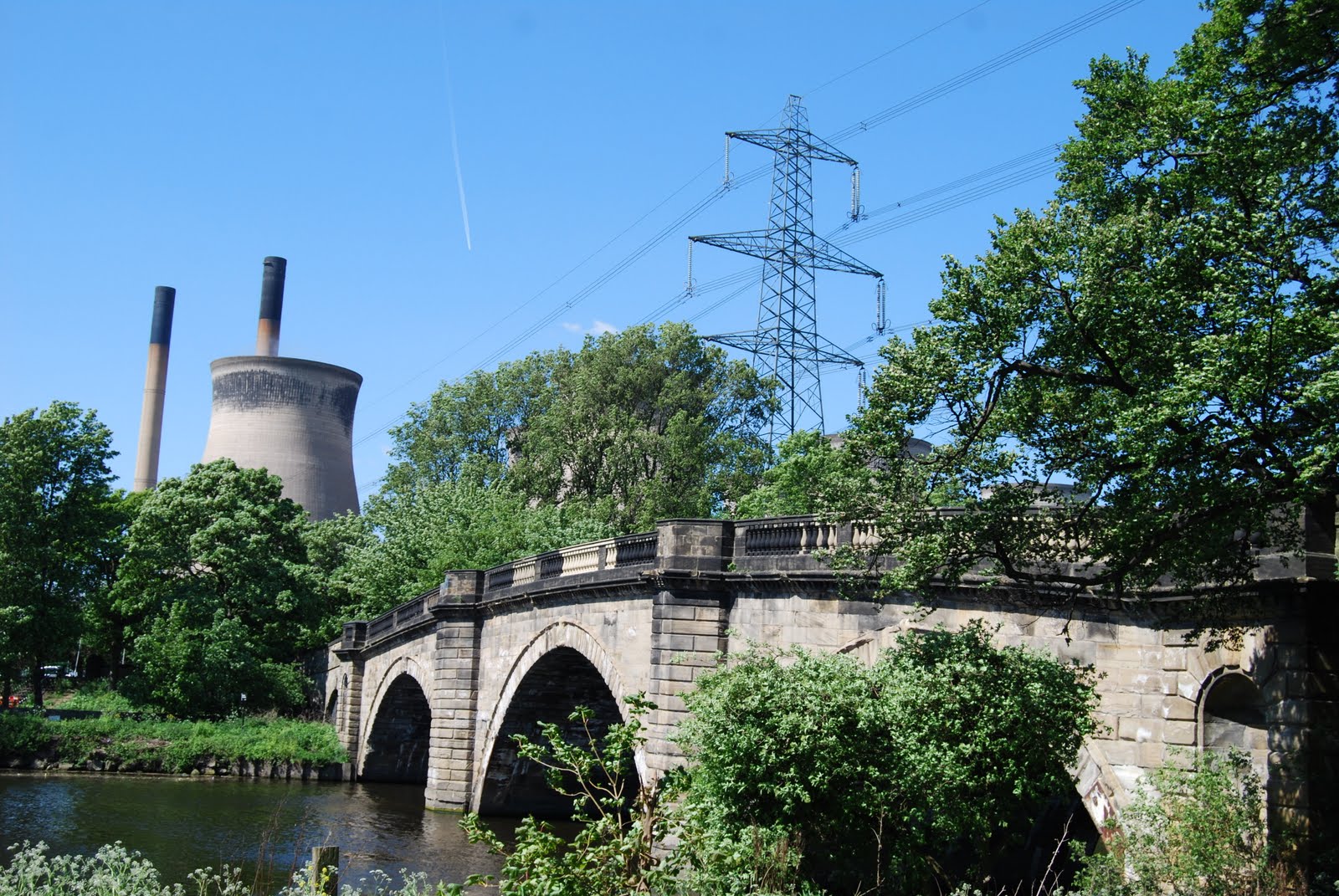
Ferrybridge isn’t everyone’s idea of a day out.  In fact most people don’t notice the village at all.  They’re too busy looking at the power station as they hurtle along the A1. Today the place is an island surrounded by fast flowing traffic and a spider’s web of flyovers and tarmac. 

There is, apparently, a Neolithic henge here.  Unfortunately, due to our poor navigation skills we found ourselves wandering around a housing estate and then heading briskly towards the A1.  We gave up in the end. It clearly isn’t on the same scale as Stonehenge.

The real reason for visiting Ferrybridge was due to the battle that took place here in 1461 on the 28th of March- the day before the more famous Battle of Towton- rather than a desire to walk amidst the sound of roaring traffic or to enjoy a close up view of a powerstation that can be seen for miles around. 

Take yourself back in time.  It’s three months since the Battle of Wakefield.  The Duke of York’s head and that of his twelve year old son, Edmund, are on display in York.  Despite this, the Lancastrians have been kept out of London and have had to come north once more.  They are being pursued by Edward of York – he wants revenge for the death of his father and brother.  It is not a good time to be living in this part of Yorkshire.

Lord Fitzwalter is sent by Edward to find a way across the River Aire.  There is a bridge at Ferrybridge.  Fitzwalter arrives; it all looks very peaceful- birds singing that sort of thing- and orders camp to be made.  Crucially, he fails to set adequate guards before taking himself off to his tent to catch up on his beauty sleep.  The following morning he gets a very nasty surprise in the form of Lord Clifford and his cavalry- a bunch of Lancastrians.  It doesn’t look good for the Yorkists.  It definitely isn’t good for Lord Fitzwalter who pays for his carelessness with his life. 


Lord Clifford very sensibly destroyed the bridge that was here all those centuries ago and made sure that his archers were lined up to prevent the Yorkists from setting up the medieval equivalent of a bailey bridge but despite his efforts the Yorkists crossed the river three miles further up led by Lord Fauconberg.  Clifford, the man who killed twelve year old Edmund of York in revenge for the death of his own father at the Battle of St Albans attempted to retreat but was killed before reaching the Lancastrian camp.  The Yorkists were able to head north.  The scene is set for the 29th March and one of the bloodiest battles that has ever happened on English soil.

The bridge that we crossed no longer takes traffic.  Its claim to fame is that its part of the old Great North Road. 

You’d have to be keen on battlefields to visit though.